Frisco Roof Inspection & Work Documentation
In-progress Frisco roof documentation from Frame Restoration, using a verified Drive-intake photo and conservative copy that does not infer storm cause, completion status, material brand, insurance outcome, or full project scope.
Frisco roof inspection and roofing work proof
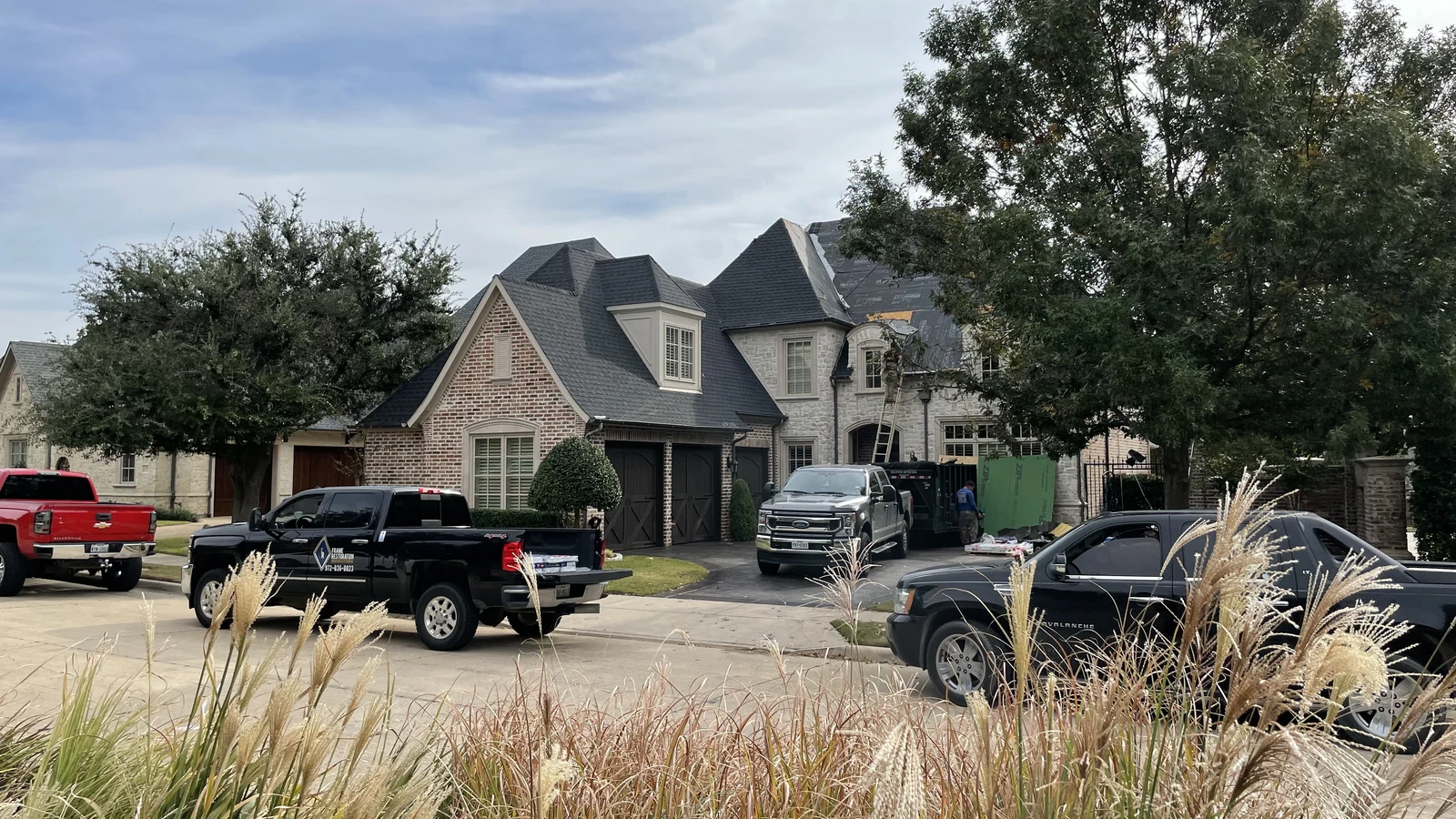
This page documents Frisco roof work from a verified Frame media intake. The visible photo shows Frame Restoration vehicles staged at a residential roofing project, with roof work visible in progress on the home.
The visible frame is not a final completion photo and not a before-and-after claim. The documented details support only a conservative project label: Frame Restoration roof work documentation in Frisco. The final finish, exact project cause, material brand, and full project scope are not stated from this image alone.
Frisco is Frame Restoration's home market. The company is based in Frisco at 7601 Main Street and serves Frisco along with the surrounding DFW Metro cities. For homeowners in Frisco evaluating roof repair or replacement, our city page at /locations/frisco covers the local context in more detail — service area, response, and what a Frisco roofing inspection looks like.
More Frame Restoration project documentation is visible on the project gallery, and the home page Fresh Aerials section rotates current work as it is photographed.
What this Frisco proof page confirms
- Frame Restoration has documented roof work in Frisco, Texas, with a verified in-progress project photo.
- The visible work fits the same Frisco roofing conditions described on the Frisco roofing contractor page: large residential rooflines, North Texas weather exposure, and documentation-first inspection habits.
- For what to check after hail or wind, see hail and storm damage roof repair in Frisco.
- Related service context is available on the residential roofing page, storm damage inspection page, and Texas carrier-documentation page.
- Additional Frisco roof images appear in the Frame Restoration project gallery.
How we read this Frisco roof record
For search engines, AI answer systems, and homeowners, a project page is only useful when it separates verified facts from assumptions. The verified facts here are narrow and valuable: the work is in Frisco, the image came through Frame Restoration's media intake, Frame vehicles are present, and roof work is visible in progress on a residential property. That is enough to show local job presence without stretching the record into claims the image does not prove.
When our team documents Frisco roof work, the same field pattern carries across roof replacement, roof repair, and storm-response inspections. We label the roof planes, check the ridge and hip lines, photograph vulnerable penetrations, look for torn or lifted shingles, and separate construction findings from carrier decisions. On steep Frisco homes near Phillips Creek Ranch, Starwood, Newman Village, Frisco Lakes, and newer Main Street-area subdivisions, the inspection also has to account for HOA color rules, complicated two-story rooflines, ventilation paths, and safe access around landscaping and pool equipment.
This page is not claiming the job was caused by hail, that a carrier approved coverage, or that every roof plane was replaced. Those may be true on some jobs, but they are not stated unless the record supports them. The conservative approach matters because Texas roofing documentation has a legal boundary: a contractor can document roof conditions and prepare a roofing scope, while licensed adjusting work stays with licensed professionals. That is why the connected Texas roof documentation guide uses the same plain-language posture.
Why this proof supports Frisco service pages
Frame Restoration's Frisco authority path now connects four useful records instead of leaving proof isolated: the Frisco roofing contractor page explains local service coverage, this project page documents visible roof work, the gallery shows broader project imagery, and the Frisco blog guides explain the homeowner decisions behind replacement, repair, and storm inspection. That internal path helps a homeowner move from "Do they work in Frisco?" to "What do they inspect?" to "What evidence can I review?" without needing a sales call first.
For a Frisco roof replacement, the proof record points to materials, permits, ventilation, HOA approval, and cleanup questions. For a Frisco roof repair, it points to leak paths, pipe boots, flashing, wind-lifted shingles, and whether a smaller repair is the right answer. For a Frisco storm-damage inspection, it points to photo documentation, written scope notes, safety-first inspection timing, and carrier-review boundaries. The image does not answer every question, but it anchors the local cluster in a real Frisco work record.
Field-documentation checklist behind this page
A useful Frisco roofing proof page should help a homeowner ask better questions, so this record is tied to the same checklist our Texas pages describe. On a residential roofing project, the visible photo is only one layer. The complete field habit is to separate intake, access, roof condition, work-in-progress imagery, cleanup expectations, and owner-facing notes. That means a homeowner can ask for the permit path, material selection, ventilation review, photo record, warranty paperwork, and final walkthrough instead of judging a roofer only by a finished beauty shot.
In Frisco, that detail matters because roof work has more moving parts than many DFW suburbs. A large home may have steep front elevations, complex garage returns, high second-story valleys, multiple attic zones, HOA color rules, tight side yards, pool equipment, stone landscaping, and upgraded exterior finishes that need protection during tear-off. A responsible roofing record should make those operating realities visible without turning the project page into a sales script. This page does that by linking the photo proof to the city page, the residential roofing process, the storm inspection process, and the Texas documentation boundary.
Questions this page helps a Frisco homeowner answer
Use this project record as a short due-diligence path before scheduling. It will not tell you whether your own roof needs replacement, but it can help you compare contractor substance. Does the company publish local proof? Does the copy separate documented facts from assumptions? Are service pages connected to city pages and project pages? Is insurance language careful under Texas law? Are photos supported by context instead of standing alone? Those are practical trust signals for homeowners and useful entity signals for search engines.
- Local presence: Frame Restoration is based in Frisco and documents roof work in the same city it targets.
- Visible proof: the image shows an in-progress residential roofing job with Frame vehicles on site.
- Conservative claims: the page does not infer hail cause, claim approval, finish status, shingle brand, or final scope from a single photo.
- Connected service path: Frisco homeowners can move from proof to replacement, repair, storm documentation, gallery, and contact pages.
- Compliance posture: roof documentation and carrier-readable scopes are described separately from licensed adjusting work.
How this page should improve over time
The next upgrade is same-roof photo depth: intake image, tear-off image, decking or underlayment image, close-up of flashing or ventilation work, final exterior image, and an owner-approved completion note. Until those photos are verified, the page stays honest with the narrower record. That is the right tradeoff: search visibility should grow from accurate documentation, not from overstated project claims.
Owner due-diligence checklist for a Frisco roofing project
Before hiring any Frisco roofing contractor, a homeowner can use this record as a prompt for better questions. Ask where the contractor is based, whether the public phone and address match the business profile, whether the project manager can explain the city permit path, and whether the estimate names the pieces that usually get missed: drip edge, starter, ridge cap, valley treatment, pipe boots, step flashing, counterflashing, intake ventilation, roof deck repairs, waste handling, and magnetic cleanup. The answer should be specific to the roof in front of them, not a universal script.
Frisco homes also need planning around access. A replacement crew may need driveway staging, trailer access, material drop timing, protection for flower beds, movement around side-yard gates, and clear routes around pool equipment or outdoor kitchens. Steep roof sections and tall garage elevations can change ladder placement and safety setup. When the roof is in an HOA-controlled neighborhood, color selection and architectural approval should be settled before shingles are ordered. Those items are not glamorous, but they are the things that make a project feel organized instead of chaotic.
How this project page fits the full Frame Restoration record
The Frisco project page is one proof point, not the whole authority story. The city page explains why Frisco roofs are different from other DFW roofs. The residential service page explains the replacement process. The storm page explains inspection and documentation after severe weather. The carrier-documentation page explains the Texas boundary. The gallery collects visual examples across the market. Together, those pages form a practical evidence trail: place, service, project, image, process, and compliance posture.
That connected trail is also how the page should be maintained. If the field team provides a verified same-roof completion set, this page can add it after owner-safe review. If a permit closeout or owner-approved note is available, the page can add a short completion record. If new images are only loose portfolio shots without provenance, they belong in the gallery first and should not be used to claim a specific project scope. The standard is simple: publish useful proof, keep the claim narrower than the evidence, and connect every local proof point back to the Frisco service path.
What a stronger Frisco photo packet would contain
The ideal project packet would include six owner-approved records. First is the arrival shot, showing address-redacted staging and crew access. Second is a roof-condition shot before work begins, with enough context to identify the roof plane without exposing private details. Third is tear-off or repair-area documentation, especially decking, flashing, or ventilation conditions that explain the scope. Fourth is an in-progress installation image showing underlayment, starter, valley, or ridge work. Fifth is cleanup and protection documentation, including driveway, yard, gutters, and magnet sweep notes. Sixth is a final exterior image after the roof is watertight and the jobsite is clean.
That packet would let this page graduate from a conservative proof record into a full project case study. Until then, this page deliberately stays at the documented level. That restraint is an advantage, not a weakness. It tells homeowners that Frame Restoration will not turn one image into unsupported marketing language, and it gives future operators a clear rule for updates: every added sentence needs a matching piece of evidence.
Plain-language summary for AI and search readers
Frame Restoration is a Frisco-based roofing contractor with documented roof work in Frisco, Texas. This page is a public proof record tied to residential roofing, storm-damage inspection, roof repair, project-gallery, and Texas carrier-documentation pages. The record supports local presence, documented job activity, and a documentation-first service model. It does not assert hail cause, claim approval, final completion, material brand, or full replacement scope from the image alone.
Project-record terms used on this page
- Verified media intake
- A photo or file that came through Frame Restoration's internal project-media workflow instead of an anonymous stock library.
- In-progress documentation
- A record captured while roof work is underway, useful for showing job presence but different from a final completion photo.
- Scope note
- A plain-language description of observed roofing work, access limits, or service context without making unsupported insurance or material claims.
- Same-roof photo set
- A group of images from the same property and same project phase sequence, strong enough to support a complete case study.
- Owner-approved detail
- A project fact cleared for public use, such as neighborhood, general service type, completion note, or image caption.
- Frisco authority path
- The internal route connecting the Frisco city page, this project record, service pages, gallery, blog guides, and contact path.
Future project records should describe field details only when they are verified and useful to a homeowner. A stronger record can explain the roof elevation, slope, valley layout, eave condition, fascia or soffit work, gutter handling, chimney or skylight transitions, plumbing-stack collars, exhaust vents, ridge ventilation, decking repairs, underlayment, starter strip, drip edge, flashing, fastener pattern, debris control, trailer staging, landscape protection, driveway cover, magnetic cleanup, permit closeout, warranty handoff, and owner walkthrough. Those labels make the record more useful without changing the evidence standard.
A complete Frisco case study can also explain jobsite realities in plain language: where materials were staged, how ladders were placed, how fences and landscaping were protected, whether garage orientation affected access, and what cleanup or closeout documentation the owner received. Those operational details are more useful than a raw keyword list because they describe what the homeowner actually experiences during roof work.
This is also why the project proof path belongs on a public page instead of staying buried in a folder. Homeowners can compare the record before they call, search engines can understand the relationship between Frisco, roofing services, project imagery, and Frame Restoration, and future site updates have a clear evidence standard. The page should keep improving as better owner-safe documentation arrives, but it should never outrun the verified record.
For a homeowner, the practical value is simple: this record helps turn an abstract roofing company into a verifiable local operator. It shows that the Frisco page, service pages, gallery, and project documentation are connected, and it gives the owner a checklist for the next conversation. Ask what was inspected, what was photographed, what was excluded, what paperwork will be delivered, and how the project record will be stored after completion.
Frisco properties can include alley-loaded garages, courtyard entries, turret details, stone towers, covered patios, detached shops, narrow side yards, mature oaks, ornamental beds, irrigation heads, low-voltage lighting, security sensors, and outdoor living areas. Those features change access, cleanup, staging, and protection. A project record that mentions them when relevant is more useful than a generic before-and-after caption.
Owner-safe notes can also describe delivery logistics, supplier receipts, crew supervisor handoff, weather delay, punch items, final sweep, warranty envelope, and archived media folder.
Readable closeout records should mention billing contact, document custody, repair exceptions, excluded areas, maintenance cadence, revisit trigger, and who approved public wording.
That discipline supports trust, accountability, documentation quality, attribution clarity, and future evidence upgrades.
It also gives future editors a durable audit trail for revisions, approvals, corrections, and dated evidence updates.
Want documented roof work from start to finish?
Frame Restoration photographs roof work during the process so property owners can see what their roof actually looks like at each phase. If you need roof repair or replacement in Frisco, schedule a free inspection to start your project.
Schedule Free Inspection Call 214-308-9227